

In dozens and hundreds of films — especially from the 1970s and ’80s — you often see a character (Louis de Funès is unforgettable in The Wing or the Thigh) who starts describing a wine simply by looking at what’s in the glass, before examining its aromas. This is — or perhaps was — the first step in tasting. It made much more sense then than it does today, but there is still a set of important information you can obtain about a wine from a purely visual examination: from style to age, structure, and, sometimes, potential faults.
- Why Visual Examination Still Matters
- What the visual exam tells about bottles wines
- Visual analysis in the glass
- 1. Light, background, and first impression
- 2. The shades of white wine
- 3. Rosé — a palette for connoisseurs
- 4. Red wines: between freshness and evolution
- 5. Color intensity — how “dense” does the wine look?
- Faults visible to the naked eye
- Wine Legs / Tears
- Conclusion: Wine Tasting Starts with Your Eyes
Why Visual Examination Still Matters
Over the past few decades, technological advances have transformed the world of wine. Stainless steel tanks, increasingly precise filtration systems, improved winery materials, and modern sanitation practices have made it easier than ever to produce clean, stable wines.
Visible defects are now rare – but not impossible.
More importantly, color itself offers insight. If you know what to look for, it can set expectations. A Pinot Noir that is not nearly transparent may suggest a more extractive style than typical for the variety. A deeper golden hue in a Pinot Gris often indicates oak maturation.
What the visual exam tells about bottles wines
Even before opening a bottle, you can learn something.
If the bottle is clear, the task is easier – but even darker glass can reveal certain signs.
If you notice cloudiness, filament-like formations, greyish-white clumps, or what looks like a thin, jellyfish-like “vinegar mother” at the bottom of the bottle, it is best to avoid it. Similarly, steer clear of white wines with pronounced brownish tones or red wines showing premature brick or brown hues – especially if the wine is meant to be only a few years old.
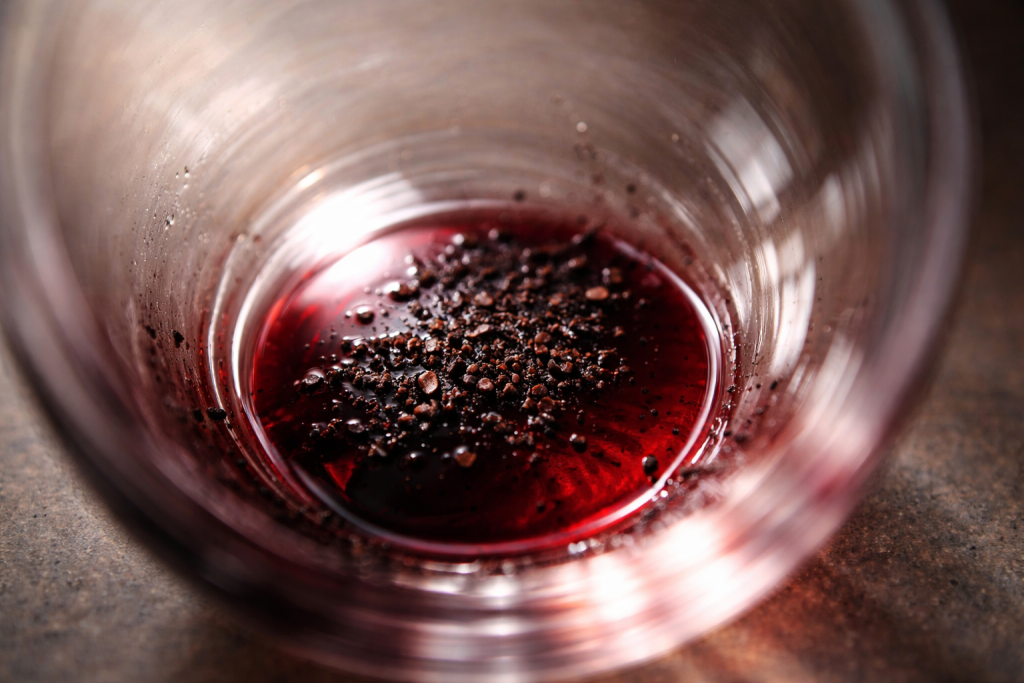
On the other hand, small crystalline deposits should not concern you. In white wines, they may resemble tiny shards of ice; in red wines, coarse reddish grains. These are tartrate crystals – a natural result of the interaction between acids and minerals present in the wine. They are harmless and do not affect flavor.
Visual analysis in the glass
1. Light, background, and first impression
Pentru a observa corect culoarea, ține paharul de picior, nu de cupă. Înclină-l la 45° deasupra unui fundal alb și observă atât centrul vinului, cât și marginea (meniscul).
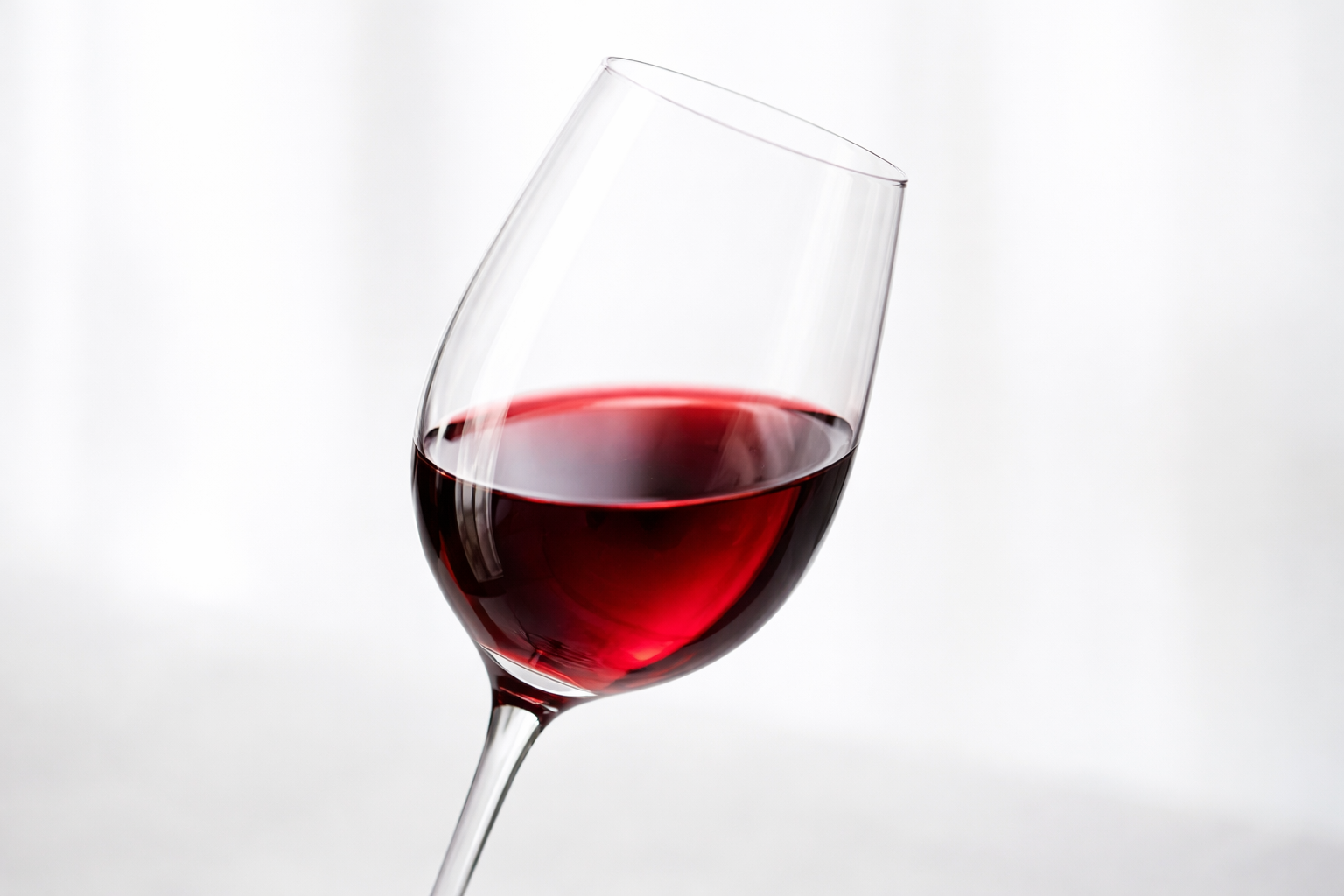
To observe color correctly, hold the glass by the stem, not the bowl. Tilt it at a 45° angle over a white background and observe both the center of the wine and the rim (the meniscus). A healthy wine should be clear and bright. Brilliance suggests freshness and stability. A dull or matte appearance may indicate advanced evolution or improper storage.
2. The shades of white wine
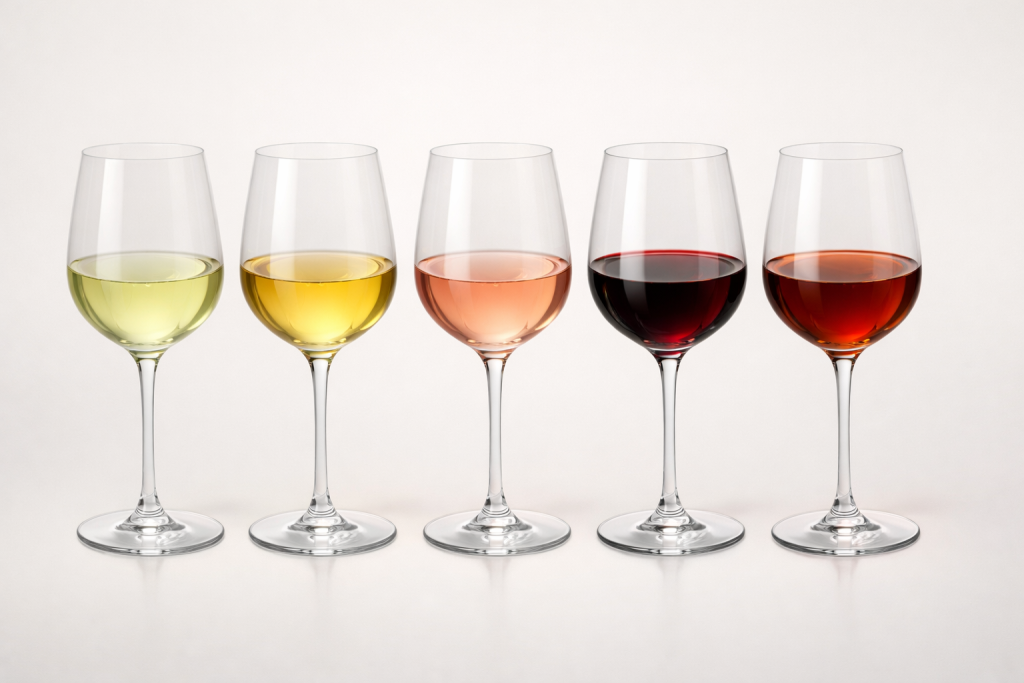
White wines can vary from pale straw, almost colorless, or pale straw with greenish highlights in very young wines, to golden, honeyed, or even amber tones in mature wines.
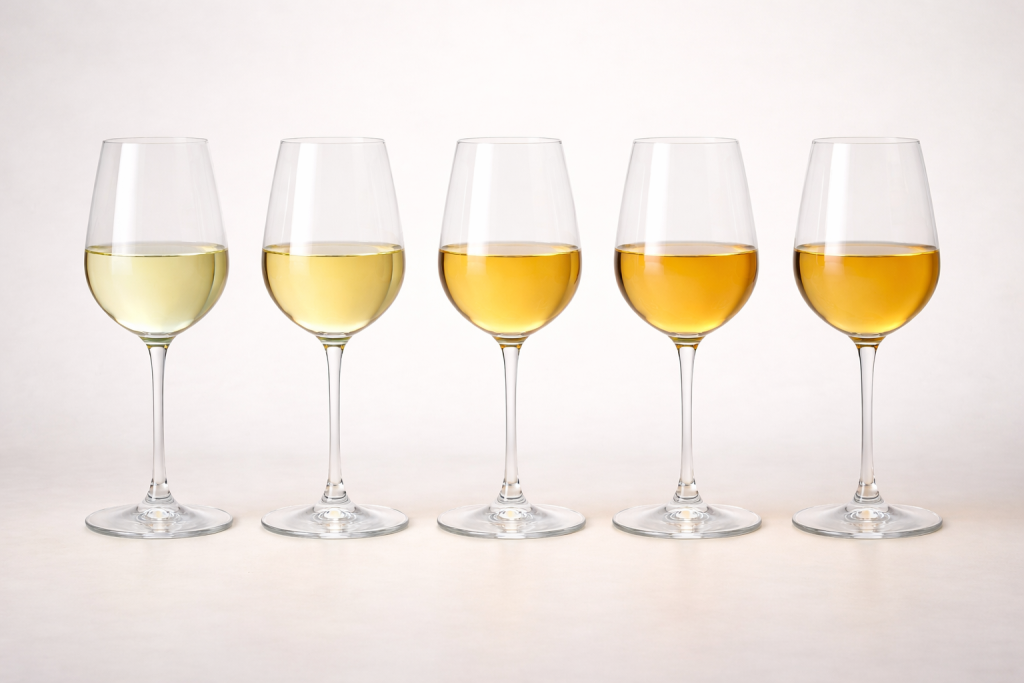
An oaked Chardonnay or a white wine with a few years in bottle will show a deeper, warmer color. Be careful, though: if a white wine has a pronounced brown tint and lacks brightness, it may be a sign of excessive oxidation.
Descriptors: beyond the terms above, you may also hear expressions used to describe white wines such as blonziu, jasmine, solar, honeyed, Persian yellow, wheat/corn yellow, 18 carats, and so on. These are not dictionary expressions; you don’t need to memorize them or argue against them. It’s up to each person to associate a color with their own experiences. And if someone says a wine is “Naples yellow,” while you think it’s closer to chrome yellow or the “Arles” yellow in Van Gogh’s paintings, we’re telling you there’s no point arguing over such nuances instead of enjoying the wine.
3. Rosé — a palette for connoisseurs
With rosé wines, things get a bit more complicated. Color is (in 99.9% of cases) contained only in the skins, which are also the part of the grape where aromas are concentrated. To make rosé, skin contact must be very short — only a few hours — or even non-existent (“press color,” or even the color of ravac must) when grapes are harvested at full ripeness or even slightly overripe.
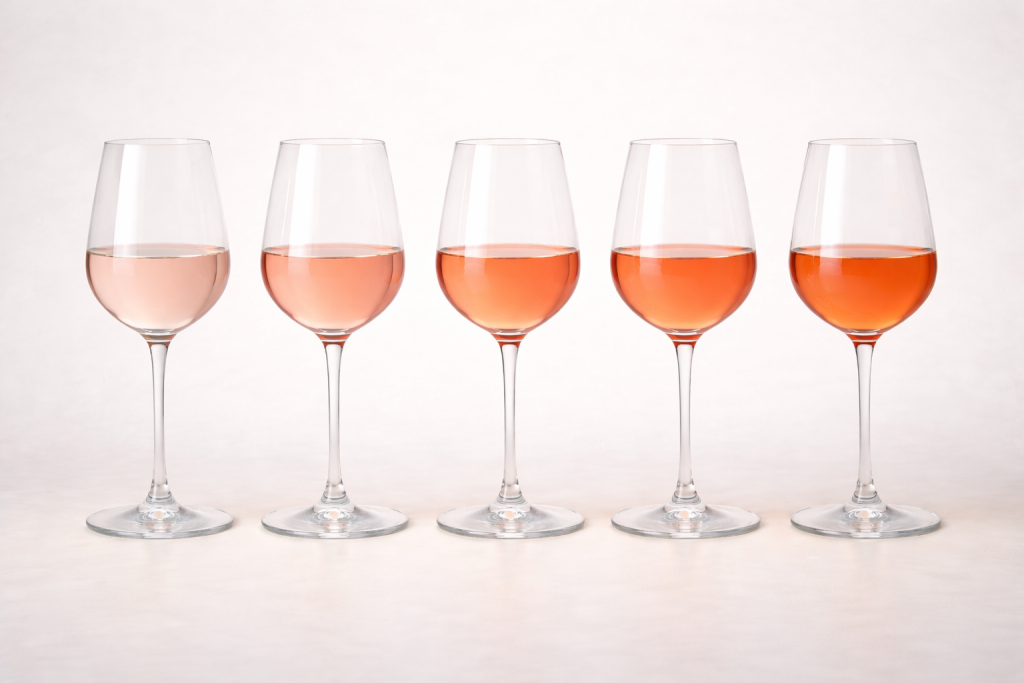
The palette ranges from very pale shades to intense colors in the violet or orange spectrum, depending both on technical decisions and on the grape’s natural color.
Here you’ll find a few established shades, from very pale pink (Provençal) to rose petals, geranium pink, salmon, antique pink, fondant pink, peach, or almost orange peel (not to be confused with orange wine!).
In general, very pale rosés are associated with delicate, elegant styles, while more intense hues can indicate greater extraction and a more pronounced fruity character.
Rosé evolves in color quite quickly. As it ages, it loses the freshness of its pink tones and takes on warmer, slightly coppery notes.
4. Red wines: between freshness and evolution
With young red wines, grape variety matters a lot. From the pale ruby of Pinot Noir to the intense violet of Tempranillo, each black grape variety has its own shades. You’ll find young wines that are purple, blood-red with violet tones or even bluish reflections, ruby red, carmine, or jasper.
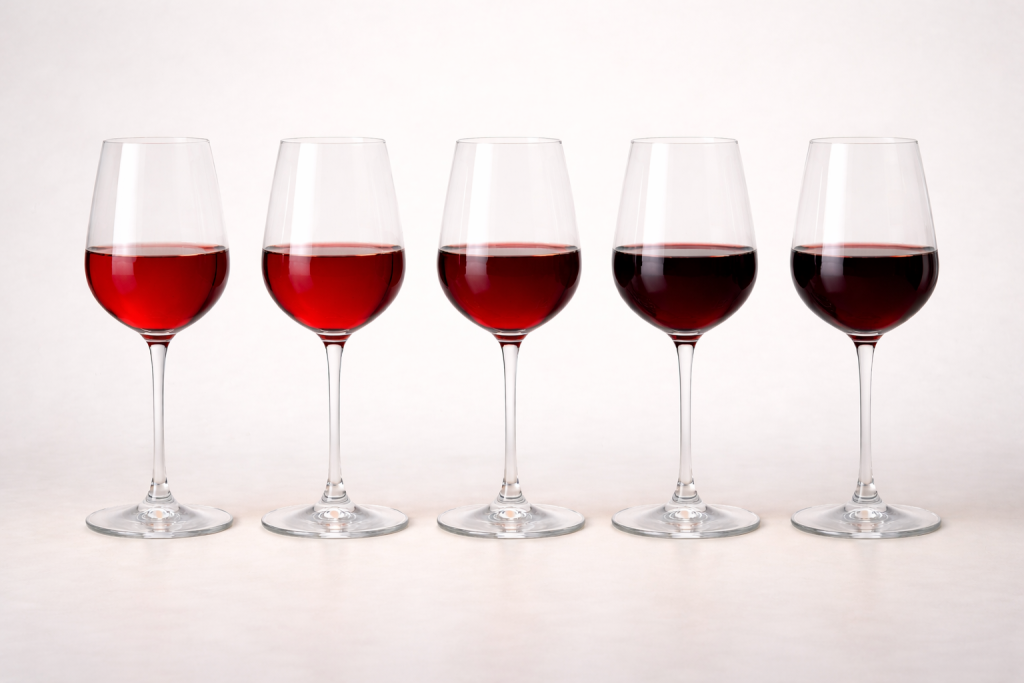
With maturity, these evolve toward a more translucent ruby, garnet, with brick-like accents, and after extended aging become predominantly brick-colored, with brownish-red or coppery hues.
By looking at the meniscus, you can observe these changes best. A brick or copper rim is a clear sign of a wine’s maturity.
5. Color intensity — how “dense” does the wine look?
Beyond hue, the concentration of color matters too. If you can see clearly through the wine, you probably have a lighter style in your glass. If it’s opaque and barely lets light pass through, it may be a wine with a stronger structure.
Faults visible to the naked eye
The visual examination can signal certain problems right from the start:
- Abnormal haze — a still wine should be clear. A milky look or particles in suspension can indicate instability.
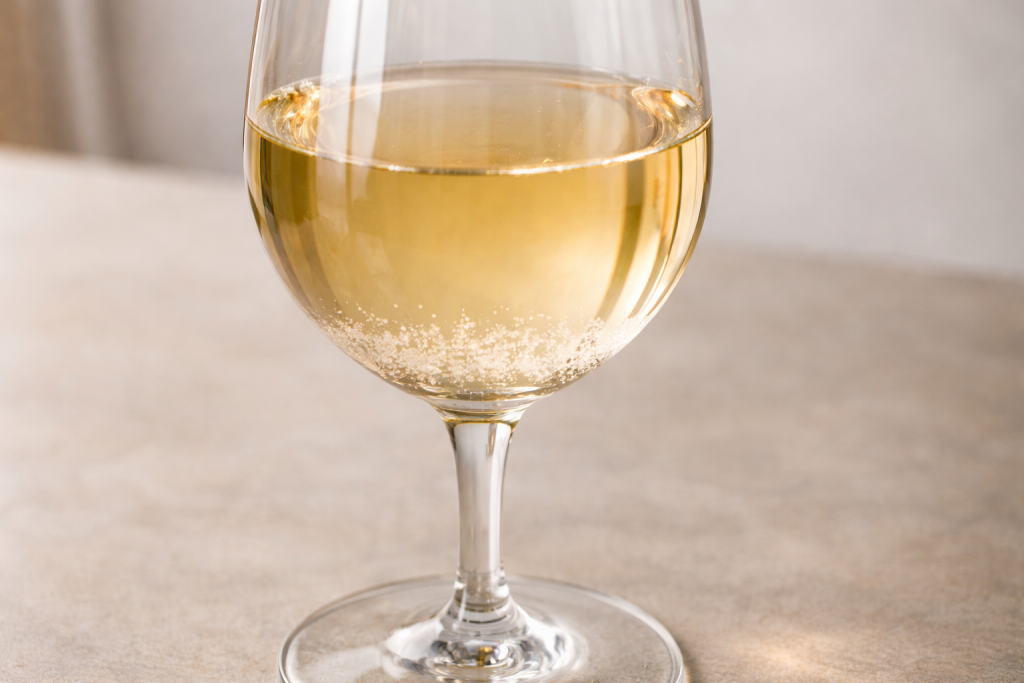
- Unexpected bubbles — in a still wine, the appearance of fine bubbles can suggest unwanted refermentation in bottle. If you see very fine “pinprick” bubbles on the glass, especially in fresh white wines, this may be due to the use of carbon dioxide as an inert gas to protect the wine (not for the long term, however). Confirmation — both for refermented wines and very fresh ones — only comes with the olfactory exam, which we’ll talk about in the next episode.
- Unusual color for the style — white wines with a strong brown tint are most likely oxidized. Again, this depends on style, age, and sugar concentration; some old sweet wines can offer wonderful surprises.
For fresh red wines, any premature brown tint suggests excessive evolution or improper storage. - Opalescent, whitish, or grey wines probably suffer from protein haze/instability.
- If the wine seems oily, or even denser than oil, it is most likely a ropy wine. In its early stages, ropiness doesn’t affect taste and aromas, but these begin to deteriorate quickly (1–2 months after the fault sets in).
- Flor / film on the wine — easy to identify — isolated whitish patches that look oily. You’re not going to drink a wine with strange floating “islands” that look like mold, are you?
- Deposits of an unusual color at the bottom of the bottle, or unusual clumps of particles in suspension (colloidal precipitates), or grey, black, or brownish-red deposits.
Wine Legs / Tears
The streaks a wine leaves on the glass — visible not only when you taste, but also when you swirl the glass to aerate the wine — were traditionally praised as a sign of a “good” wine. In reality, these traces (wine legs in English, larmes du vin in French) are related to alcohol concentration and to sugar/glycerol in the wine.
First of all, the number of “legs” or “tears” is related to alcohol concentration — more legs generally mean more alcohol (look up the Gibbs–Marangoni effect). The speed at which the drops run down and the thickness of the “legs” indicate wines that are sweeter or higher in glycerol.
Conclusion: Wine Tasting Starts with Your Eyes
The next time you pour a glass of wine, do not rush. Hold it up to the light. Give it a few quiet seconds of attention.
Wine tasting begins with observation.
The visual examination is not an empty ritual. It is the first filter, the first clue, the first conversation with the wine.