

No/low alcohol wine is gaining the interest of Romanian wine producers and importers, in the light of its global growth. In recent years, alcohol-free and low-alcohol wine has moved from being a niche shelf curiosity to becoming a strategic category for many international companies. We are no longer talking only about “Dry January” or products “for designated drivers.” We are witnessing a behavioral shift — more moderate consumption, alternating between alcoholic and non-alcoholic drinks within the same occasion, and a generation that is increasingly attentive to balance.
But how much of this is a passing trend, and how much is a real opportunity? And, more importantly, what does it mean for Romania, where the traditional definition of wine is associated with a minimum alcohol content (8.5%), and 0.0% products fall under a different regulatory and labeling framework?
What Is Happening Globally
Industry data shows that the no/low segment continues to grow in mature markets. According to IWSR analyses, the overall no/low category is on a positive trajectory through 2028, with the strict no-alcohol segment (0.0% or below 0.5%) growing faster than the broader alcoholic beverages market, which is advancing modestly or stagnating.
In the UK, one of the most dynamic markets, the category has seen strong growth in recent years, supported by well-developed distribution, dedicated retail shelf space, and a culture of moderate consumption. Annual growth is estimated at around 19% through 2028. The concept of “zebra striping” — alternating between alcoholic and non-alcoholic drinks during the same evening — is already embedded in urban consumer behavior.
Another important signal is validation through dedicated competitions. The Global Low & No Alcohol Wine Masters, organized by The Drinks Business, evaluates alcohol-free and low-alcohol wines in blind tastings judged by Masters of Wine and international buyers. The existence of medals, distinct categories, and formal evaluation standards shows that the segment is increasingly treated with professional seriousness.
At the same time, major industry players are strengthening their positions. Moët Hennessy’s investment in French Bloom — a premium alcohol-free sparkling wine — sends a clear message: this category is no longer an experiment, but a strategic portfolio direction.
Still, there is realism in the discourse. Respected wine critics have pointed out that wine is more difficult to “treat” than beer or spirits when alcohol is removed. Alcohol is not just an ingredient; it contributes to texture, balance, and the transport of aromas. For this reason, technology and know-how make the difference between a technically correct product and one that is genuinely convincing.
Why Prodducers Invest in No/Low
Beyond the trend itself, there are three clear motivations.
The first is demographic. Younger generations consume differently: they drink less frequently but more consciously. The second is portfolio strategy: producers want to remain relevant in a context where social pressure and alcohol-related regulation are increasing. The third is value opportunity — in many markets, no/low wines are sold at prices comparable to traditional wines, sometimes even higher.
The challenge is that the investment is not simple.
Investment: Necessary, but Without a Clear Payback Timeline
Dealcoholization technology — whether reverse osmosis, centrifugation, vacuum distillation, or other methods — involves significant costs. It is not just a piece of equipment. It is a full process: testing, recipe adjustment, stability work, labeling, and brand positioning.
Moreover, the volume required to reach break-even depends almost entirely on the market. If a producer already exports to the UK or Germany, where the category is established and distribution channels are clear, the scenario is very different from attempting to build demand from scratch.
Here lies the main uncertainty: the return on investment — which may range from €150,000–200,000 to well over €1,000,000 — is not standardized and depends on the technology chosen, production capacity, and integration into the existing production flow. There is no “manual” that guarantees payback in three or five years. It depends on volume, pricing, distribution partnerships, and the brand’s ability to persuade consumers.
In the absence of a solid domestic market, the realistic model for a Romanian producer remains export-oriented or based on technological partnerships, rather than a large-scale investment aimed exclusively at Romania.
The Romanian Low/No Alcohol Wine Market in 2026
On the local market, alcohol-free wines are currently present almost exclusively through imports. Prices are often comparable to, or even higher than, entry- or mid-range traditional wines, which limits the potential audience.
Demand exists, but it remains small and concentrated in large cities, within urban lifestyle, corporate, and premium HoReCa environments. This is not yet a mainstream category.
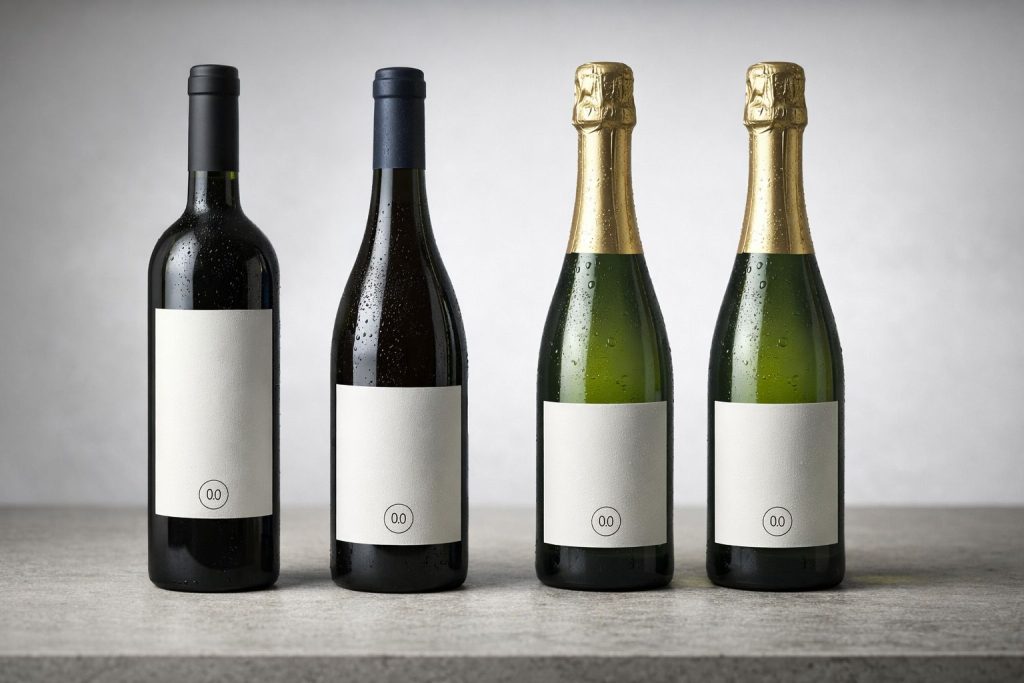
At the same time, it is clear that some Romanian wineries, like Budureasca or Cramele Recaș, are closely monitoring the phenomenon. There are discussions within the industry about technological infrastructure and projects under consideration, but commercial launches remain cautious. The strategy of “waiting for the right moment” is not without logic: the investment is substantial, and the domestic market does not guarantee sufficient volume.
For Romania, the real opportunity is unlikely to be a domestic boom in 2026, but rather a strategic positioning in export markets — especially in niches where aromatic varieties or sparkling styles could perform better in low- or 0.0% versions.
Is No/Low the Future of Wine?
No. Traditional wine is not disappearing.
However, no/low appears to be becoming a permanent category in mature markets. It will not replace traditional wine, but it will complement it. It will exist as an alternative for specific occasions, for moderate consumption, and for segments of consumers who might otherwise leave the category entirely.
For Romanian producers, the question is not whether the trend exists. It does. The real question is whether they have:
- the necessary capital,
- partners capable of structuring an offer for the domestic market,
- access to external distribution,
- and the patience to invest in a category with an uncertain payback timeline.
For most, it may be wiser to observe and test at a small scale. For a few well-capitalized players, no/low could become a strategic differentiator in the years ahead.
It is not a magic solution. But neither is it a mirage.

Which Romanian Grape Varieties Could Work in No/Low?
Looking at international experience, the wines that perform better in alcohol-free or reduced-alcohol versions are typically those with pronounced aromatic profiles or sparkling styles. The reason is straightforward: the dealcoholization process reduces some volatile compounds and affects texture. Varieties that begin with high aromatic intensity or strong natural acidity have more “room to lose” while remaining expressive after processing.
In this context, several Romanian grape varieties are theoretically interesting. Tămâioasă Românească, with its floral and lychee notes, could behave similarly to Muscat or Gewürztraminer in a no/low version. Busuioacă de Bohotin, with its aromatic and lightly muscat character, might work in slightly off-dry or sparkling styles. Fetească Regală, more neutral but with good natural acidity, could be suitable for 0.0% sparkling wines — a style that globally appears technically easier to balance.
That said, these remain technological hypotheses, not commercially validated results at scale. Without pilot testing and professional sensory evaluation, any conclusion remains theoretical. The potential exists — but it must be demonstrated, not assumed.
Taste Remains the Main Challenge for Wine Enthusiasts
One of the most consistent criticisms from the expert community concerns the sensory quality of alcohol-free wines and the gap that still exists compared to the experience of traditional wine. Renowned wine critic Jancis Robinson has stated that many dealcoholized wines are “a poor substitute for the real thing,” describing them as “hollow” and lacking the depth and character that define quality wine. Even the better examples, she suggests, are often tolerated rather than truly enjoyed.
This perception is not purely subjective. Scientific research on consumer acceptance indicates that sensory quality scores tend to decline as alcohol levels are reduced, and tasters can identify differences between traditional wines and dealcoholized or low-alcohol versions in terms of body, aroma intensity, and finish.
From a technical standpoint, the explanation is clear: alcohol contributes significantly to texture, balance, and the “carrying” of aromas in wine. When it is reduced or removed, part of the structural framework that makes wine feel complete to an experienced taster is lost.
This helps explain why many wine enthusiasts argue that, although there are interesting no/low examples — and some that work well as alternatives for specific occasions — the taste is still not sufficiently convincing to replace the traditional wine experience for passionate consumers.